How to Set Your Freelance Rates (Formula + AI Prompts)
Some links may be affiliate links. If you buy through them we may earn a commission, at no extra cost to you. We only recommend tools we have tested.
Most new freelancers pick a rate by looking at what others charge, then lowering it “to be safe”. That’s how you end up fully booked and still short of money. A better approach: start from what you need, then check the market.
Step 1: Calculate your minimum rate
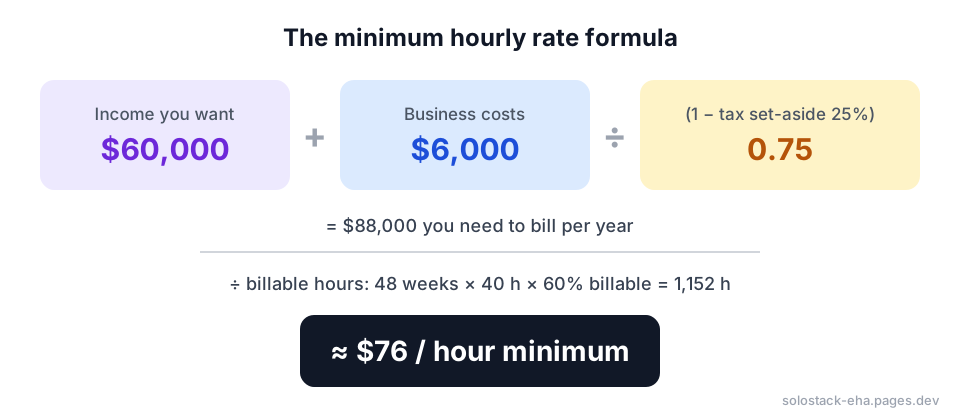
The formula:
Minimum hourly rate =
  (Income target + Business costs) ÷ (1 − Tax set-aside) ÷ Billable hours
Worked example
| Item | Value | Notes |
|---|---|---|
| Income target (what you take home) | $60,000 | Your salary, before personal tax |
| Business costs | $6,000 | Software, equipment, internet, insurance, accountant |
| Tax set-aside | 25% | Placeholder, so ask an accountant for yours |
| Working weeks | 48 | 52 minus holidays and sick days |
| Hours per week | 40 | |
| Billable share | 60% | The rest is admin, sales, learning |
| Billable hours | 1,152 | 48 × 40 × 0.6 |
Calculation: ($60,000 + $6,000) ÷ 0.75 = $88,000 to bill per year. Divided by 1,152 hours, that’s ≈ $76 per hour.
That number is your floor. Below it, you are effectively paying to work.
The billable-hours trap: new freelancers assume 40 billable hours a week. In reality, finding clients, emails, invoicing and revisions take 30–50% of your time. If you’re just starting, use 50% or even 40%.
Step 2: Research what your market pays
Your floor tells you the minimum. The market tells you the ceiling. AI is a good starting point for research, but don’t trust any rate it states as fact. Use it to find where to look:
I'm a freelance [skill, e.g. "React developer"] targeting clients in
[US/UK], specialising in [niche].
1. What factors usually move rates up or down in this field?
2. Where can I find real, current rate data (surveys, marketplaces,
   communities)? List specific types of sources.
3. What questions should I ask other freelancers to benchmark my rate?
Don't invent numbers. If you are unsure, say so.
Then check real sources: rate surveys from freelance communities, public profiles on marketplaces filtered by your skill and country, and honest conversations with peers.
Step 3: Turn your rate into packages
Clients compare packages, not hourly rates. Ask AI to help structure them:
My minimum rate is $[X]/hour. I offer [service]. A typical project takes
[N] hours. Design three packages (Basic, Standard, Premium) with clear
deliverables, a fixed price for each, and what makes Premium worth it.
The Standard package should be the obvious best value.
Example for a website-copy freelancer:
| Package | Deliverables | Price |
|---|---|---|
| Basic | Homepage copy, 1 revision | $750 |
| Standard | Homepage + 3 pages, 2 revisions, SEO titles | $1,900 |
| Premium | Standard + brand voice guide + 30-day support | $3,200 |
Most clients pick the middle option. That’s the one you design to be profitable.
Step 4: Present the price with confidence
The way you say your price matters as much as the number. Never apologise for it, and always tie it to the result. Here’s a prompt to practise:
Act as a cautious client who thinks my $[price] quote is too high.
Push back 3 times with realistic objections. After each of my replies,
tell me how convincing I was and how to improve.
If a client still asks for a discount, reduce the scope, not the rate. Our difficult client email prompts include a ready-made reply for exactly this.
When to raise your rates
- You’re booked solid for 4+ weeks
- More than ~80% of prospects say yes immediately (too cheap!)
- You’ve added a new skill or a strong case study
- It’s been 12 months since your last increase
Raise rates for new clients first, then give existing clients 30–60 days’ notice.
The bottom line
Calculate your floor, research the market, package your work and quote with confidence. Do the maths once with your own numbers. It takes 20 minutes and can change your income for years.
Frequently asked questions
Should I charge hourly or per project?
Use your hourly rate to calculate prices, but quote per project whenever the scope is clear. Clients prefer a fixed price, and you earn more as you get faster.
How often should I raise my rates?
Review them at least once a year, and whenever you are fully booked for more than a month. A full calendar is the clearest sign your price is too low.
Is the 25% tax set-aside correct for me?
It is only a planning placeholder. Tax depends on your country, income and expenses, so ask a local accountant for the right percentage and replace it in the formula.
Keep reading

How to Write a Client Proposal with ChatGPT (5 Prompts That Work)
A step-by-step method for freelancers to draft winning client proposals with ChatGPT or Claude in 20 minutes, with copy-paste prompts and a checklist.

ChatGPT Prompts for Replying to Difficult Client Emails
Copy-paste AI prompts to answer angry, demanding or scope-creeping client emails calmly and professionally, plus the 4-step CALM framework freelancers use.